

Background
Client: Undisclosed – Onshore Wind Farm
Services: Grid Code Compliance & Connection Studies
Location: Scotland, UK
Date: July 2025

Project Overview
A major UK renewables developer appointed EPS to deliver comprehensive grid compliance and connection studies for a new onshore wind farm in Scotland. The site, designed to provide just under 50MW of clean energy to the grid, required full verification against the UK Grid Code before connection approval.
With increasing additions of renewable energy sources onto the network, grid stability and compliance are non-negotiable. EPS was engaged to carry out the required studies to demonstrate that the wind farm could connect safely, securely, and in line with regulatory requirements.
Scope of Work
We were commissioned to assess the compliance of the client’s wind farm against the latest grid code requirements in the UK. To help achieve this, our power systems specialists built a model of the wind farm and its respective 132/133kV substation via industry-standard software, DIgSILENT PowerFactory.
Using this detailed model, we carried out a full suite of Grid Code studies, including:
- Reactive power capability (VQ and PQ) analysis
- Voltage control and reactive stability
- Fault Ride Through (FRT) and Fast Fault Current Injection (FFCI)
- Frequency sensitivity studies (covering over-frequency and under-frequency events).
- Controller verification and validation (to confirm the dynamic behaviour of the power park).
Findings & EPS Solutions
Through our simulations, we identified a reactive power shortfall under lagging conditions. Therefore, to improve reactive capability and achieve compliance, EPS recommended installing a shunt capacitor bank at an available spare 33kV switchboard bay. This solution extended the wind farm’s operating range to fully comply with V–Q and P–Q requirements.
Before

After:

Reactive power capability assessment showing initial non-compliance (left) and full compliance achieved after installation of a shunt capacitor (right)
Subsequent studies confirmed:
- Voltage stability: Wind turbine generators (WTGs) successfully responded to voltage step changes, demonstrating compliant reactive behaviour.
- Fault Ride Through: The project’s WTGs remained connected during a range of simulated network faults (3-phase, 2-phase, and single-phase), injecting reactive current to the grid as required.
- Frequency response: Over-frequency studies showed compliant WTG behaviour during load rejection scenarios, maintaining stability within permitted limits.
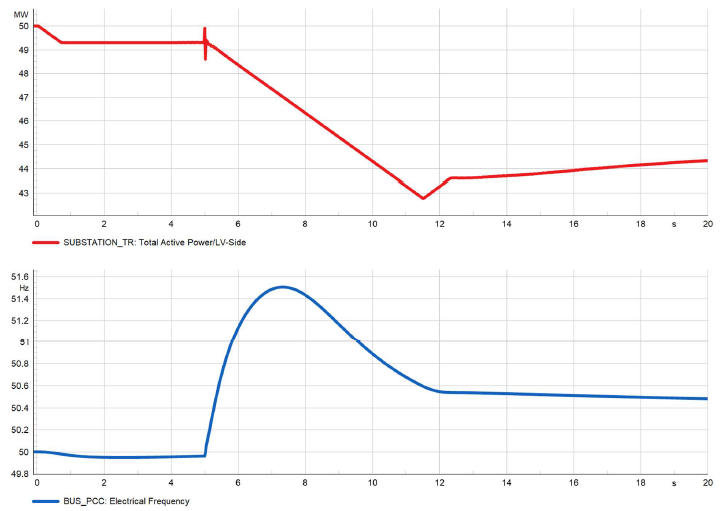
Wind farm frequency response under full load rejection, demonstrating compliance with Grid Code over-frequency limits (LFSM-O).
Some aspects, including under-frequency mode and full controller model validation, were placed on hold pending final WTG data from the manufacturer. EPS provided a roadmap to complete these outstanding studies in alignment with developer and DNO requirements.
Outcome
EPS’s studies demonstrated that the majority of the Grid Code compliance requirements were met, with clear engineering solutions provided for areas of initial non-compliance. The project now has a clear pathway to securing full grid connection approval.
By applying specialist expertise in grid compliance studies, EPS ensured the project progressed toward connection approval with minimal delay. Our proactive approach to identifying and resolving compliance challenges gave the developer confidence that the site could meet the technical requirements of the UK grid.
This case reinforces EPS’s capability in the renewables sector, delivering detailed engineering studies that balance regulatory precision with practical solutions for project delivery.