

Project Snapshot
Client: Undisclosed energy infrastructure client
Location: UK
Services: Power System Studies – TRV / RRRV Assessment
Date: May 2026
An existing 400kV harmonic filter circuit breaker had been identified as potentially unsuitable for its transient recovery voltage and rate of rise of recovery voltage duty. At this voltage level, that finding can lead to equipment replacement, additional mitigation, design changes, programme delays, additional project costs and/or lost revenue for an existing plant.
We were appointed to independently reassess the circuit breaker duty, review the previous modelling approach, and determine whether a more detailed representation of the network, equipment, and transient behaviour could support a clear engineering recommendation.
Using PSCAD, we rebuilt the network model with enhanced detail, incorporated manufacturer data, and assessed the circuit breaker against IEC 62271-100 transient recovery voltage envelopes. The study concluded that the selected 550kV rated circuit breaker was suitable for the relevant fault duties associated with the harmonic filter application, helping the client avoid disproportionate 400kV mitigation measures.
The Engineering Challenge
The client required an independent technical review after a previous assessment indicated that the selected circuit breaker may not be suitable for the required switching duty.
The concern centred on transient recovery voltage, commonly referred to as TRV, and rate of rise of recovery voltage, or RRRV. These parameters are critical in high-voltage circuit breaker applications because, after a breaker interrupts fault current, the voltage across its contacts recovers rapidly. If the voltage rises too high or too quickly, the breaker may be unable to interrupt the fault successfully.
For a 400kV harmonic filter application, the consequences of an unsuitable breaker assessment can be significant. Replacing the selected breaker, adding mitigation equipment, or modifying the network design could introduce considerable cost and complexity. Before any major decision was made, the client needed a detailed technical assessment to understand whether the issue was caused by the breaker itself, the modelling assumptions, or the severity of a particular fault scenario.
Why the Assessment Mattered
At transmission voltage level, modelling assumptions can have a direct impact on project decisions. If a simplified model overstates the severity of transient overvoltages, a project may be pushed towards mitigation measures that are technically possible but not proportionate in practice.
The client needed the study to answer three key questions.
- Was the selected circuit breaker genuinely unsuitable for the application?
- Were the original modelling assumptions sufficiently representative of the real network and equipment?
- Could the breaker be accepted for the relevant fault duties when assessed against the applicable standard and technical guidance?
Our role was not simply to repeat the previous assessment. The value of the study came from reviewing the modelling basis, improving the representation of the system and applying engineering judgement to the interpretation of the results.
EPS Approach
We began by reviewing the existing assessment in detail and identifying where the model could be refined to better represent the actual network, plant and equipment.
We then rebuilt the system in PSCAD with greater modelling fidelity. Where appropriate, we retained the original assumptions but introduced additional engineering assumptions where these were justified by manufacturer data, equipment behaviour or recognised technical guidance.

Key modelling enhancements included representing the circuit breaker as a 550kV unit in line with manufacturer data, modelling the transformers as non-ideal components to include winding resistance and core losses, and representing busbars and equipment interconnections using PI sections with travelling-wave behaviour. These refinements improved the representation of damping and transient response across the system.
We also incorporated circuit breaker grading capacitors based on manufacturer data, detailed BESS inverter system representation, IEEE frequency-dependent surge arrester modelling and updated stray capacitance values based on IEEE guidance and PSCAD recommendations. These details were important because each can influence the calculated TRV and RRRV response during and immediately after fault interruption.
The simulations were carried out across a range of fault types at the harmonic filter location. We also varied the fault inception point across switching angles to identify the worst-case TRV and RRRV conditions for each scenario.
The Technical Findings
The study assessed several fault scenarios, including single-phase-to-earth, two-phase-to-earth, phase-to-phase, three-phase-to-earth and ungrounded three-phase faults.
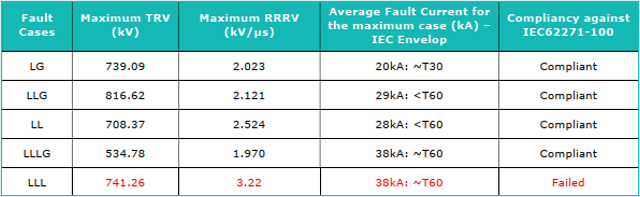
The results showed that the selected circuit breaker remained within its TRV/RRRV capability for the applicable single-phase-to-earth, two-phase-to-earth, phase-to-phase and three-phase-to-earth fault cases. In the technical study, these corresponded to the LG, LLG, LL and LLLG simulation cases, as shown in the table above.
The only case that showed non-compliance was the ungrounded three-phase fault, referred to in the technical study as the LLL fault. In this scenario, the calculated RRRV exceeded the breaker withstand level. We investigated this result further before reaching a final recommendation, rather than treating it as an automatic rejection of the selected equipment.
That distinction was important. The study showed that the non-compliant result was not specific to the harmonic filter circuit breaker alone. If a similar ungrounded three-phase fault were applied to other circuit breakers within the substation, those breakers would also be unlikely to interrupt the fault within their standard TRV/RRRV capability. This indicated that the issue was associated with the exceptionally severe nature of the fault scenario, rather than a specific weakness in the selected breaker.
Applying Engineering Judgement
We reviewed the ungrounded three-phase fault case against relevant international references and practical breaker application guidance.
The study identified that this type of fault has a very low probability of occurrence in a substation environment. The reviewed references stated that the probability of an ungrounded three-phase fault in a substation is less than 1.3% and that many technical references do not treat this fault as a governing case for standard TRV assessment.
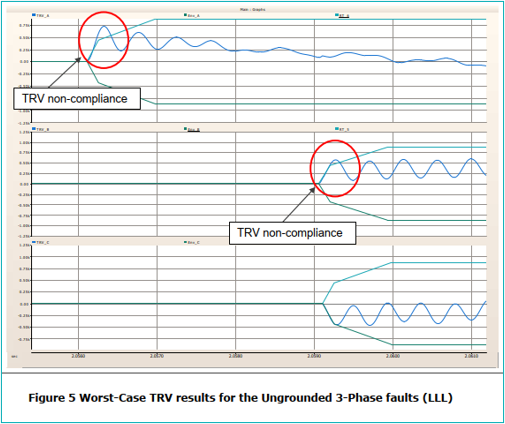
Following this review, we concluded that the ungrounded three-phase fault should not be treated as the governing case for this assessment. The fault was not dismissed. It was considered in context: very low probability, non-standard behaviour and wider evidence that the issue was not breaker-specific.
The study therefore combined detailed modelling, standards-based assessment and practical engineering interpretation to support a proportionate project decision.
Mitigation Assessment
We also investigated whether practical mitigation could reduce the TRV and RRRV values for the ungrounded three-phase fault case.
The most direct technical solution would have been to connect a shunt capacitor in parallel with the circuit breaker terminals. Based on the simulations, this would have required capacitance of approximately 10 µF per phase. At 400kV, this would equate to approximately 502 MVAr of reactive power, which was not considered a practical solution.
A further theoretical option was to connect the capacitor bank through a transformer. In practice, this would have required an additional 400/33kV transformer, adding significant cost and design complexity.

We also considered fault current limitation. Reducing the fault current could have helped bring the calculated TRV within a less restrictive breaker capability envelope. However, at 400kV, the design and installation of fault current limitation equipment is complex, costly and difficult to implement.
The mitigation review confirmed that, while theoretical options existed, they were not practical or proportionate for the application. This reinforced the recommendation that the selected breaker could be accepted for the relevant harmonic filter duties.
Project Outcome
We recommended that the 550kV circuit breaker be accepted for the harmonic filter application.
The recommendation was based on the study results, the low probability of the only non-compliant scenario, the finding that the issue was not specific to the selected breaker, and the lack of practical mitigation measures proportionate to the risk.
By carrying out a more detailed TRV/RRRV assessment, we helped the client move forward with a clear basis for accepting the selected circuit breaker, while avoiding unnecessary 400kV mitigation.
Client Value
The study provided an independent technical review of a high-impact equipment suitability concern.
By improving the modelling representation of the system, plant and equipment, we were able to assess the TRV/RRRV response with greater confidence and translate complex simulation outputs into a practical engineering recommendation.
The client avoided moving directly towards costly mitigation or equipment replacement in response to a low-probability fault scenario. Instead, the project team had a standards-aligned basis for accepting the selected breaker for the duties relevant to the application.
Why This Matters for High-Voltage Projects
In high-voltage projects, TRV and RRRV studies can directly influence equipment acceptance, protection strategy, harmonic filter integration and whether mitigation is genuinely required.
A simplified or overly conservative model can create unnecessary concern. An underdeveloped assessment can miss genuine risk. The right approach requires detailed system modelling, accurate equipment representation, understanding of the relevant standards and the ability to distinguish between applicable operating duties and exceptional theoretical scenarios.
Our engineers combine specialist power system study capability with practical design judgement, helping project teams make informed decisions that support safety, compliance and commercial control.

If you are assessing circuit breaker suitability, harmonic filter integration or transient recovery voltage performance on a high-voltage network, we can provide independent studies to support clear, standards-aligned project decisions. All our reports are comprehensive, showing detailed methodology and all results are clearly explained.
Our team supports clients with TRV/RRRV studies, power system modelling, circuit breaker application assessments, grid code compliance, protection studies, arc flash assessments and wider electrical engineering consultancy across complex power infrastructure projects.